The back story
Gas lamps, tertulias and churros at dawn: Madrid’s cafés, the back story
Tertulias, chess and churros after midnight: how Madrid’s cafés became its second living room.

Photo Credit
Image courtesy of © WeI-chieh Chiu from Taipei, Taiwan · CC BY-SA 2.0 via Wikimedia CommonsMadrid’s cafés began as shops for cold drinks and ices, then turned into parliaments of talk, lit by gas and furnished like palace drawing rooms. Two of the great 19th-century survivors still pour, the churros still come out after midnight, and the pastry shops around Sol are older than most of the city’s museums. Here is how the ritual grew, and how to keep it today.
From ice-cream shop to tertulia
The Madrid café did not begin as a temple of coffee. It grew out of the botillería, a small shop for cold drinks and ices, made for people passing through. From the early 19th century, says the city’s tourist office, its successors became the stage for the tertulia: a regular gathering where the same chairs heard the same voices argue about books, bullfights and whatever had happened that morning.
The rooms were dressed to impress, often imitating palace drawing rooms and lit by the new gas lamps. Of the famous names of that century, the Pombo near the Puerta del Sol, where Ramón Gómez de la Serna presided over his tertulia, the Levante, the Príncipe, the Suizo and the Fornos, only two still stand. Madrid lost most of its parliaments of talk; the talking simply moved down the street.
Two survivors, one year apart
Café Comercial opened on 21 March 1887 on what is now the Glorieta de Bilbao. Antonio Machado had a reserved table; Gloria Fuertes and Gabriel Celaya were regulars, and a chess club met on the first floor. It closed in 2015, the City Council moved to protect it, and it reopened in 2017. The motto on its wall, “para ser hay que estar”, is the whole philosophy of the café: to be anyone, you have to turn up.
On 15 May 1888 Gumersindo García opened a café on the Paseo de Recoletos and named it after his home town, Gijón. Galdós, Ramón y Cajal, Valle-Inclán and Lorca came; later Camilo José Cela, Francisco Umbral and the actor Fernando Fernán Gómez, who founded a literary prize in the café’s name. In 1949 the architect Carlos Arniches Moló swapped the gas lamps for electric light and added the oak panelling.
Chocolate at the end of the night
San Ginés approaches the café from the other end of the day. Its building in the Pasadizo de San Ginés went up in 1890 as an inn and tavern, and in 1894 it became a churro workshop. Locals nicknamed it La Escondida, the hidden one, for its tucked-away passage, and its arch appears in Benito Pérez Galdós’s Episodios Nacionales. It is, by its own account, where many people take their first chocolate of the year, if they are patient enough to queue.
Madrid lost most of its parliaments of talk; the talking simply moved down the street.
The sugar trade around Sol is older still. The Agudo family founded the Antigua Pastelería del Pozo in 1830 on Calle del Pozo, where a bakery had worked since 1810; the Leal family took it over in 1930 and still runs it. El Riojano on Calle Mayor dates itself to 1855, La Mallorquina has been on the Puerta del Sol since 1894, and La Duquesita in Salesas, a confectioner since 1914, is now in the hands of the pastry chef Oriol Balaguer.

Photo Credit
Image courtesy of © Roberto Garcia · CC BY 2.0 via Wikimedia CommonsWhat the ritual asks of you
Madrid’s cafés keep Madrid’s hours. By the tourist office’s rule of thumb, the main meal falls between 2pm and 4pm and dinner around 9pm, and the city seldom lunches after 3.30pm or dines after 11pm. The café fills the long gaps: a coffee and a pastry mid-morning, an early-evening snack, and chocolate and churros at San Ginés long after the theatres have emptied.
A newer generation works to a different clock. Speciality cafés such as Toma Café on Calle de la Palma, Misión Café near Conde Duque and Hola Coffee in Salamanca serve a city that once took its coffee as an excuse for conversation and now, here and there, takes it for the coffee itself. Which café is the real Madrid one? The answer is the old one: whichever keeps your table.
Our advice: take a morning coffee at Café Comercial or the Gijón for the history, buy something from the Pozo or El Riojano on the walk to Sol, and leave San Ginés for after midnight, when the queue is part of the theatre. It takes no bookings, except for large groups taking a whole room.
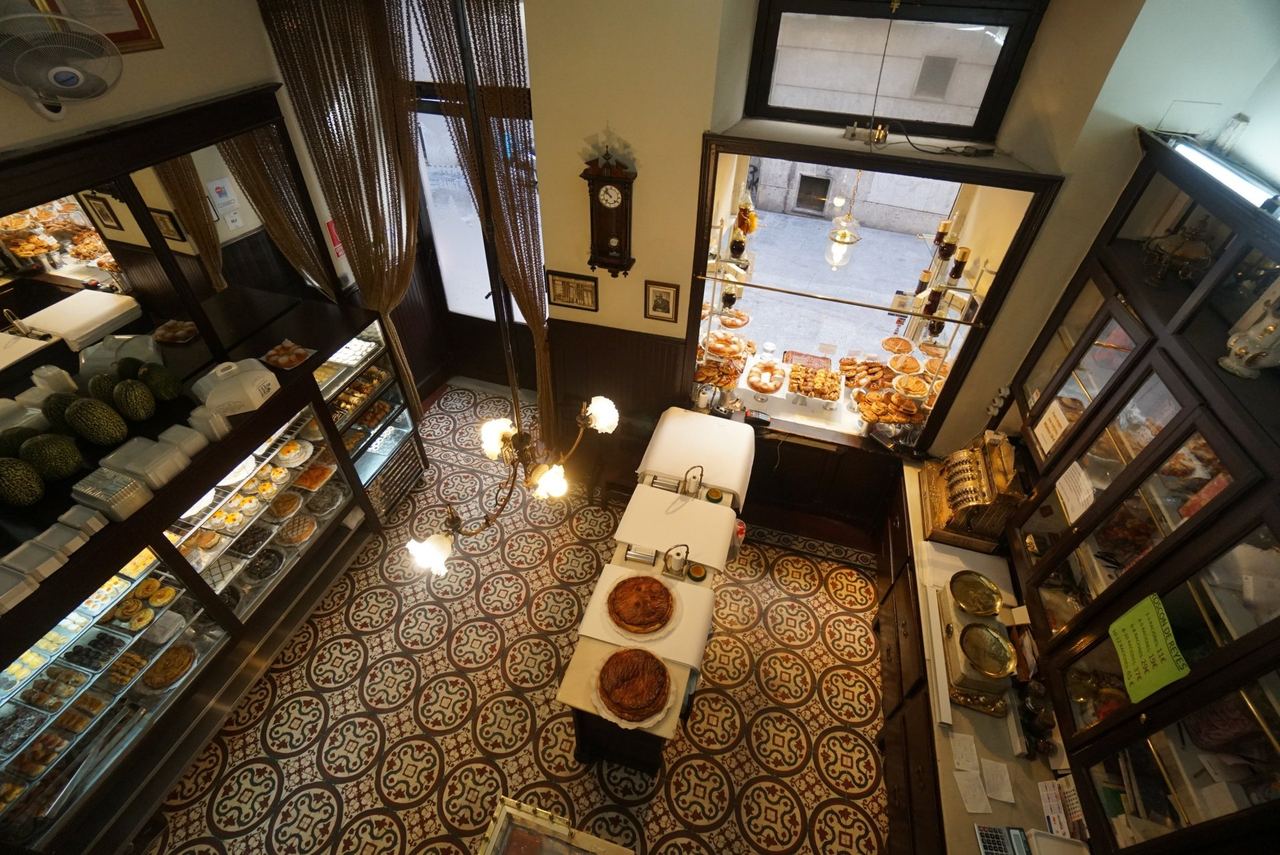
Photo Credit
Image courtesy of © Antigua Pastelería del PozoWhy it's on our list
- From ice-cream shop to tertulia
- Two survivors, one year apart
- Chocolate at the end of the night
- What the ritual asks of you
Location
The map comes from Google Maps, which sets its own cookies once it loads.
More in depth
 The back storyVermouth on tap, gin by the fire: Madrid’s bars, the back storyDraught vermouth, an English club of 1921, Chicote’s Gran Vía and jazz at the Ateneo.
 The back storyMadrid’s bridges over the Manzanares, from Herrera to PerraultThree bridges along the river park of Madrid Río.
 The back storyThe Paseo del Prado: an avenue of museums, fountains and a royal parkAn avenue of museums and a royal park. UNESCO-listed.