The back story
Promenades, avenues and a temple by the river: Madrid on foot, the back story
Europe’s first tree-lined promenade, a 1910s avenue, an Egyptian temple and a river reclaimed.

Photo Credit
Image courtesy of © Diego Delso · CC BY-SA 4.0 via Wikimedia CommonsMadrid was walking for pleasure before most capitals had pavements. Its routes tell the city’s story in layers: a 15th-century promenade now on UNESCO’s list, an avenue cut through the old town in three stages, a temple of the 2nd century BC rebuilt above the river, and a riverbank won back from a ring road. Here is where the walks came from, and how to take them.
Europe’s first tree-lined promenade
The Paseo del Prado was a place of recreation from the 15th century, says the city’s tourist office, and it counts as the first of Europe’s tree-lined urban promenades. On 25 July 2021, at a session in Fuzhou, UNESCO inscribed it with the Retiro park and the Los Jerónimos district as a World Heritage Site: Paseo del Prado and Buen Retiro, a landscape of arts and sciences, known in Madrid as the Landscape of Light.
The protected line runs from the Plaza de Cibeles to the Plaza de Atocha, past the fountains of Cibeles, Apollo and Neptune, then climbs into the Retiro. It is the walk that explains the city: an old pleasure ground for the court, now everyone’s, with the Prado, the Thyssen and the Reina Sofía set along it like volumes on a shelf.
An avenue in three stages
The Gran Vía is younger and louder. It was built between 1910 and 1931 in three stages, from Calle de Alcalá to the Red de San Luis, on to Callao and finally to the Plaza de España, and 22 old streets were to disappear for it. Three religious buildings stood in the way and the plan was bent around them, which is why the line wavers. Even a modern boulevard in Madrid knew better than to argue with a church.
Its buildings carry the story: the Metrópolis, the Casino, the Capitol, the Callao cinemas and the Telefónica tower, finished on 1 January 1930 and claimed by its own foundation as the first skyscraper in Europe. The avenue’s latest renovation was completed in 2018. Walk it from the Círculo de Bellas Artes to the Plaza de España in the last hour of daylight, when the façades catch the sun.
A temple, a river and a slaughterhouse
Above the Plaza de España stands the Templo de Debod, begun in the 2nd century BC under King Adijalamani of Meroë. When Egypt asked for international help in the 1960s, the temple was given to Madrid, rebuilt and opened to the public in 1972. It is older than Rome’s Colosseum and has, so far, outlasted every attempt to improve the view of the sunset behind it.
Down below, the Manzanares spent decades in the company of a ring road. When a stretch of the M-30 was moved underground, the riverbanks became Madrid Río, a park about 10 km long, opened in April 2011. The walk from the Puente de Segovia passes the pedestrianised Puente de Toledo and Dominique Perrault’s 274 m footbridge of interlocking spirals, and ends at Matadero, a slaughterhouse of 1921 that now trades in contemporary art.

Photo Credit
Image courtesy of © Luis García (Zaqarbal) · CC BY-SA 3.0 via Wikimedia CommonsThe river park is built for use as much as for looking: a 30 km cycling route shared with walkers, skateparks and climbing walls, and an urban beach of water jets that opens in summer, which is as close as Madrid comes to a seafront and closer than most visitors expect.
Even a modern boulevard in Madrid knew better than to argue with a church.
On Sundays and public holidays, from 9am to 3pm, La Latina belongs to El Rastro. Documents mention the market as early as 1740, and its stalls spread from the Plaza de Cascorro down the Ribera de Curtidores. Arrive early, walk downhill, and leave the climb back for after the vermouth.
Almonds in February
The last walk is a matter of timing. The almond trees of the Quinta de los Molinos, planted in staggered rows in the south of the park, flower in February and March. In the northern part stand a palacete in the Viennese Secession style and the mills, los molinos, that give the estate its name. The park opens from 6.30am to 10pm every day of the year.

Photo Credit
Image courtesy of © Malopez 21 · CC BY-SA 4.0 via Wikimedia CommonsOur advice: take the Paseo del Prado on a weekday morning, the Gran Vía at dusk, Madrid Río on a Sunday afternoon, and keep a late-winter morning free for the almonds.
Why it's on our list
- Europe’s first tree-lined promenade
- An avenue in three stages
- A temple, a river and a slaughterhouse
- Almonds in February
Location
The map comes from Google Maps, which sets its own cookies once it loads.
More in depth
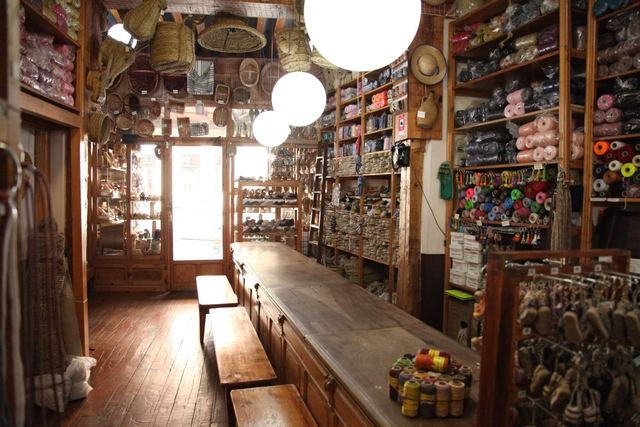 The back storyCapes, fans and the Sunday Rastro: Madrid shopping, the back storyA market of 1740, fans since 1823, espadrilles since 1845, capes since 1901 and Loewe since 1846.
 The back storyToledo, Segovia and El Escorial: day trips by train from MadridToledo, Segovia, El Escorial and Ávila by train.
 Coming soonComing soon: the tech the makers have promisedOfficially announced tech, from Gemini glasses to Meta's VR specs, plus the newest arrivals.